Research Trip to Mulu: Learning from the Penan Community of Long Iman
By Aini Jasmin Ghazalli (PhD.)

Malaysia is home to a rich diversity of indigenous communities, each possessing deep-rooted knowledge of their natural environment. In Sarawak, these communities have long relied on forest resources not only for shelter and food, but also for medicine, cultural practices, and daily survival. Among them, the Penan community is particularly known for its extensive ethnobotanical knowledge, especially the use of forest plants as medicinal herbs for both humans and animals.
In January 2026, I had the opportunity to witness this knowledge firsthand during a research expedition to Long Iman, near Mulu in Sarawak. The expedition was led by Dr. Rohaidah Haron from Universiti Malaya as the principal investigator, together with a multidisciplinary team of researchers: Prof. Madya Dr. Mohamad Maulana Magiman (UPM Sarawak), Prof. Madya Dr. Najihah Mohd Hashim (Universiti Malaya), Ts. Dr. Fauziah Abu Bakar (UPM Sarawak), and Dr. Ab. Razak Ab. Karim (Universiti Malaya). Our work focused on traditional medicine and cultural rituals practiced within the community.
Interestingly, the research also attracted international interest. A psychiatrist named Erik Kinzie from the U.S. Department of Veterans Affairs in New Orleans joined the expedition after connecting with one of the researchers through LinkedIn, highlighting how indigenous knowledge from remote communities can resonate far beyond national borders.
My participation in this journey was supported by the Kursi Pehin Sri Adenan Satem at UPM Sarawak. As part of the team studying indigenous plant knowledge, I was able to observe and document how the Penan community continues to live in close relationship with the forest. What stood out most was how their traditional ecological knowledge — built through generations of observation and practice — remains deeply relevant today, offering valuable insights into sustainable living and our relationship with nature.

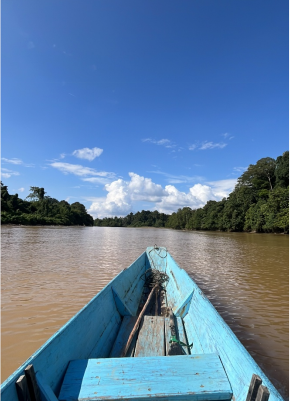
On the boat to Long Iman.
The journey to Long Iman was an adventure in itself. It began with a flight from Kuala Lumpur to Miri, followed by a small aircraft that carried us deeper into Sarawak, landing in Mulu. From there, our journey continued by boat, gliding along a winding river that serves as the main lifeline for the communities living in this remote region. The river is more than just a route of travel—it connects villages, carries supplies, and shapes the rhythm of daily life for the people who call the forest home.
When we finally arrived in Long Iman, we were greeted with warm hospitality by Mr. Esak Tu’o, the village chief (Ketua Kampung), and his wife, Mrs. Tebun Tunggang. Their kindness immediately made us feel welcome. Before setting out into the forest, the team gathered to make final preparations—checking our documentation tools, cameras, and reference materials—ensuring everything was ready for the fieldwork that awaited us.
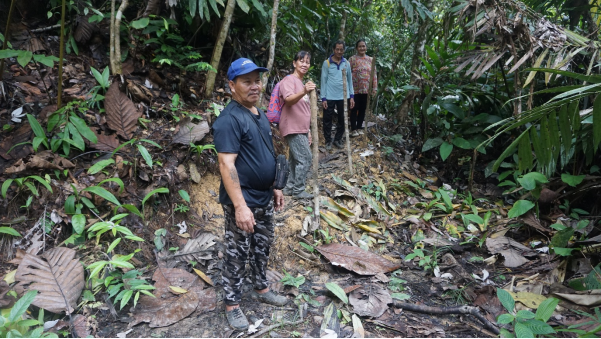
Fieldwork: Learning from the Forest
The heart of our fieldwork was a series of guided walks through the forest, led by four members of the Penan community—Mr. Esak Tu’o, Mrs. Tebun Tunggang, Mrs. Ewit Kulin, and Mr. Imang. With remarkable generosity, they shared their knowledge of medicinal plants, pointing out species along the trail and explaining how each one is traditionally used. As we moved through the forest, the research team carefully documented every plant we encountered. Photographs were taken, local names in the Penan language were recorded, and discussions were held about their medicinal properties. Later, we cross-referenced this information to identify the scientific names using a specialised plant identification application purchased for the study.
The first day’s walk, which led us along a forest trail to a waterfall, offered more than just research discoveries. Along the way, our hosts invited us to taste wild jackfruit and pineapples growing naturally in the surrounding forest. These simple moments reminded us that the forest is not merely a place of study for the Penan — it is their pantry, pharmacy, and living environment. While we had hoped to encounter durian during the trip, it was unfortunately out of season.
By the end of the walk, the team had documented at least ten medicinal plants. These plants serve a variety of purposes in the Penan community, from treating stomach aches and relieving skin irritation to providing vitamin supplements for hunting dogs. Each plant revealed a small glimpse into the depth of knowledge that the Penan people have cultivated through generations of living closely with the forest.

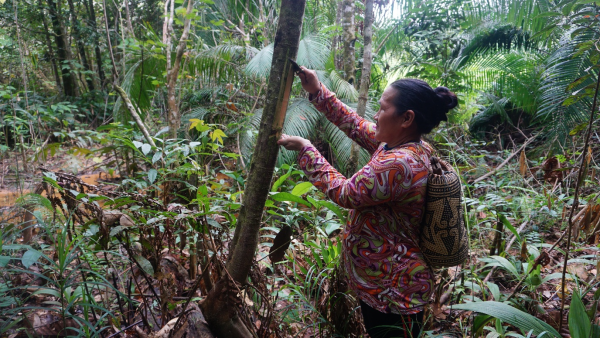
Mrs. Ewit demonstrates how to harvest the bark for medicinal uses.
Reaching the waterfall was both rewarding and refreshing. We took a much-needed break, had our lunch, and rested while soaking our feet in the ice-cold river water. One of the most memorable moments was trying a natural soap derived from forest herbs collected during the walk—an excellent example of how forest resources are integrated into daily life in a sustainable manner. After several hours, we made our way back to the longhouse, where the team rested and reflected on the day’s findings.
On the second day, we travelled by boat before hiking another hill, where we documented five additional plant species. During lunch, our Penan friends treated us to a special grilled fish. They carefully prepared and grilled the fish, and the meal was shared together with the whole group, making it a meaningful moment of cultural exchange and camaraderie.
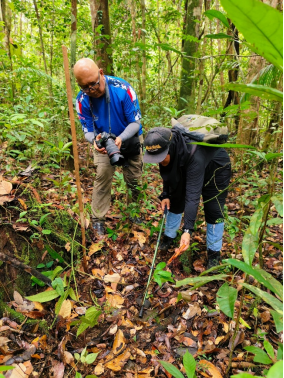


Living Sustainably: Observations on Forest Use
The trip also offered valuable insights into the realities of sustainable living and the challenges faced by indigenous communities. For the people of Long Iman, forest resources—especially timber—remain essential for daily life. Wood is used for building homes, constructing facilities, and maintaining basic infrastructure in a place where modern building materials are difficult to access. At the same time, broader issues such as logging pressure and environmental degradation pose serious long-term concerns for the surrounding landscape.
During our walk, the Ketua Kampung shared how the community had recently built a small hut with toilet facilities near the waterfall. The structure was constructed using timber sourced carefully from nearby areas. As we passed the site, we could see where only a small number of trees had been selectively logged and processed into planks and poles. The finished hut, equipped with water tanks, now serves as a resting place for both villagers and visitors. It stands as a small but meaningful example of how the community balances the use of forest resources with local needs while also supporting eco-tourism activities in the area.


Reflections
This research trip opened up meaningful opportunities for future studies. As a researcher with a landscape architecture background, the experience reinforced the importance of viewing landscapes not only as designed spaces, but as living systems shaped by culture, ecology, and traditional knowledge.
Potential research directions emerging from this experience include:
- Integration of indigenous medicinal plants into community-based landscape design.
- Ethnobotanical knowledge as a framework for sustainable landscape planning and conservation.
- Designing interpretive trails and cultural landscapes that communicate indigenous plant knowledge to wider audiences.
I strongly encourage fellow academics to step beyond conventional research boundaries, engage directly with communities, and collaborate across disciplines. Such experiences enrich our perspectives and strengthen the relevance of landscape architecture in addressing cultural, ecological, and sustainability challenges.

Date of Input: 30/03/2026 | Updated: 30/03/2026 | marini
MEDIA SHARING