From Conversation to Creation: SULAM Inclusive Design Projects in Action
Dr. Zati Hazira Ismail
GOMBAK, 4 February 2026 - Continuing from the academic visit to the Disability Services Unit (DSU), previously featured in Sensasi FRSB, Bil. 55 under the title “Connecting Through Conversation: Academic Visit to the Disability Services Unit (DSU), International Islamic University Malaysia”, the SULAM Accessible Design project has now reached its meaningful conclusion.
What began as a conversation soon evolved into a transformative learning journey. After listening to the lived experiences, challenges, and quiet resilience of the disability community, students embarked on a 17-week design process grounded in empathy and responsibility. Each student selected a user to work closely with, ensuring that every design decision was informed by real needs rather than assumptions. Over 13 intensive weeks following the visit, ideas were tested and refined, and there was continuous engagement with end users. Designing for individuals with specialised needs required them to constantly reassess their perspectives and challenge their own biases. The end user was never an afterthought; instead, they became the centre of every sketch, prototype, and iteration.
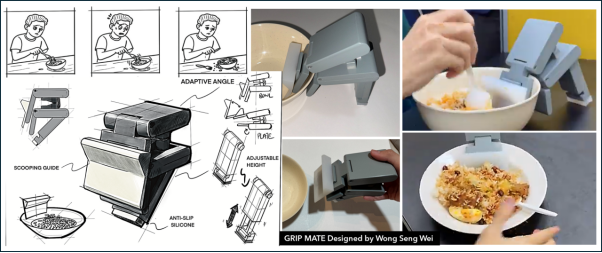
One notable project was GripMate, designed by Wong Seng Wei. Reflecting on his process, he shared that numerous iterations were necessary to ensure the product functioned effectively. Designing for someone who uses only one hand required him to rethink everyday actions that many take for granted. GripMate helps users scoop food while stabilising plates or bowls, enabling a more comfortable and dignified dining experience. Its tagline, “One Hand is Enough,” conveys a powerful message: thoughtful design can create a world where disability is not seen as a limitation.
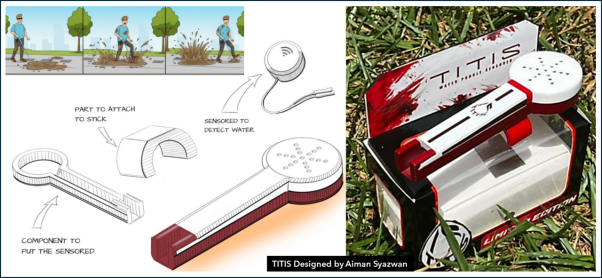
Inspired by meaningful conversations with visually impaired individuals during the project, Aiman Syazwan identified a challenge often overlooked by the sighted community: puddles along walkways that cannot be detected with a traditional white cane. Such unnoticed hazards can disrupt mobility and compromise safety, particularly in a country like Malaysia, where sudden rain frequently leaves pathways wet and unpredictable. Drawing on his interest in aquariums, Aiman creatively adapted a water-level sensor commonly used in aquariums to design an alert attachment device. The product features a compact, droplet-inspired form that symbolically reflects its purpose. He engineered the mechanism to attach easily to existing white canes, ensuring users would not need to replace familiar tools or adjust to entirely new mobility aids. This thoughtful approach prioritises convenience, adaptability, and user comfort. When the sensor detects water, it emits a beep to warn users of a puddle ahead, allowing them to adjust their path. His solution demonstrates how innovation often emerges from connecting knowledge across disciplines.
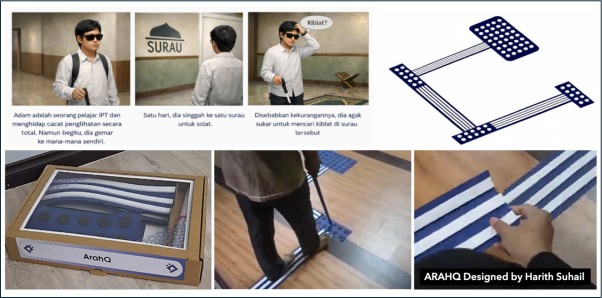
Harith took on the meaningful challenge of improving accessibility within public prayer spaces through ARAHQ, a thoughtfully designed modular tactile kit created to help visually impaired Muslims independently identify the qibla direction. His inspiration came from the story of a student who struggled to determine the correct prayer direction when entering an unfamiliar surau without assistance. ARAHQ features a series of textured tactile tiles and guiding strips that can be assembled directly onto existing floor surfaces to form clear, touch-detectable pathways. The raised patterns allow users to navigate the space confidently using their feet or a cane, while the directional layout intuitively leads them toward the qibla. Designed for flexibility, the kit is modular and portable, allowing it to be installed, rearranged, or expanded to meet the spatial requirements of different prayer areas. Importantly, Harith’s solution avoids the need for major construction or permanent architectural modifications. Its ease of installation makes it both cost-effective and practical for widespread implementation in surau and mosques, enabling institutions to enhance inclusivity without extensive renovation.
Similarly motivated to enhance religious inclusivity, Fatimah interviewed members of the deaf community and was deeply moved by the realisation that the call to prayer, a daily spiritual reminder for many Muslims, is not experienced in the same way by those who cannot hear it. Applying her newly acquired Arduino skills, she developed an Azaan Alert System that uses LED signals to notify users when it is time for prayer, complete with an on-off switch for convenience. Her design reflects how technology can bridge gaps in spiritual experiences.

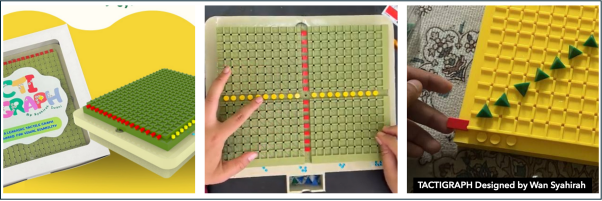
TactiGraph, created by Wan Syahirah, was inspired by a visually impaired economics professor who excels in numerical concepts but struggles to draw graphs during lectures. Her tactile pin-board design allows graph lines to be felt through touch, empowering educators and students alike to engage more effectively with mathematical visuals. The design features a structured grid surface on which raised pins and geometric markers can be arranged to form axes, plot points, and graph lines that are clearly distinguishable by touch. Colour-contrasting elements further support users with low vision, while the modular layout makes it easy to construct multiple graph types. By transforming abstract mathematical visuals into a sensory experience, TactiGraph enables educators to teach more inclusively and empowers students to interpret data independently and confidently.
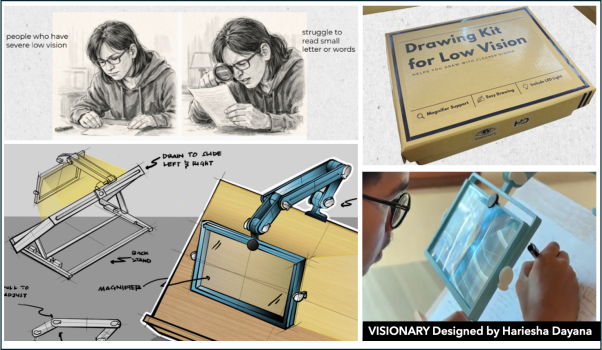
For Hariesha, the project became a profound awakening. Through her research, she learned that visual impairment exists along a spectrum from B0 (total blindness) to B3 (low vision) and that individuals within the low-vision category are frequently overlooked in mainstream product design despite their strong potential for independence when properly supported. This realisation led her to develop Visionary, a thoughtfully engineered workboard designed to enhance clarity, comfort, and autonomy in daily tasks. The design integrates an adjustable, angled board to promote better posture and reduce visual strain, paired with a mounted magnifier that can be repositioned to meet the user’s focal needs. A built-in task lighting system improves contrast and visibility, making reading, writing, and drawing significantly more manageable in various environments.
These projects represent only a glimpse into a class project that produced 31 remarkable designs, each embodying compassion translated into purposeful innovation. For me as an educator, witnessing this journey was just as transformative as it was for the students. What began as an academic exercise gradually evolved into a shared exploration of empathy, responsibility, and human-centred design. Throughout critique sessions and conversations shaped by real user feedback, we came to understand that impactful design does not always need to be revolutionary or complex. Sometimes, its greatest strength lies in responding to needs that are often overlooked, restoring dignity, enabling participation, and improving everyday experiences in quiet but meaningful ways.
This understanding was perhaps best expressed by another student in the class, Amin Aiman, who designed a checkers set for individuals with visual impairment. Reflecting on his motivation, he shared, “I love playing checkers, and it made me realise that not everyone gets to enjoy such simple pleasures.” His words capture the very essence of inclusive design: the belief that small moments of joy, leisure, and connection should be accessible to all. As the 17-week project concluded, I asked the students what they had learned most from the experience. While there were 31 unique reflections, many spoke about the emotional responsibility of truly considering their end users.
Perhaps that is the greatest lesson of all. Accessible design is not solely about accommodating differences; it is about recognising our shared humanity. When students learn to design with empathy, they do more than create products; they help shape a future that is more inclusive, compassionate, and dignified for everyone.

Date of Input: 30/03/2026 | Updated: 30/03/2026 | marini
MEDIA SHARING