Calligraphy: Blooming Lines Begin at the Point
Ts Dr Velu Perumal KMW
Calligraphy, derived from the Greek words "kallos" (beauty) and "graphos" (writing), refers to the harmonious balance of letters within a word and words on a page. Calligraphy, the art of beautiful writing, holds profound significance in the Malaysian art scene, bridging the cultural expressions of the Malay, Chinese, and Indian communities. This article explores the underlying principles and philosophies of calligraphy within these cultures to understand its aesthetic, functional, and spiritual dimensions.
Calligraphy is more than just an art form; it is a vital mode of human communication that evolved from early gestures and signs. The development of written language transformed dots and lines into meaningful words, each letter with its distinct shapes and curves contributing to the artistic charm of written communication which are believed originated from cave paintings. Writing became a significant vehicle for expressing power, legitimacy, and beliefs (Fatimah Ali & Md. Salleh Yaapar,1997). In certain cultural contexts, the prohibition of pictorial representations in religious settings elevated calligraphy as a primary form of artistic and ideological expression.
Arabic calligraphy, which is also known as Islamic calligraphy, has a long history of development and started in the early 7th century. Arabic calligraphy embodies movement, rhythm, and dynamism, evident in Mosques, Islamic buildings, and calligraphy paintings. It reflects aesthetic principles and showcases a deep appreciation for the language and culture through traditional artistic methods. The tradition Arabic artwork conveys the universality of spirituality in all cultures through the aesthetic dimension of language which reflects the long history and diversity of Muslim civilization.
The flowing lines and intricate designs convey divine beauty, bringing words to life with spiritual significance in styles like Kufi, Thuluth, Naskh, Farsi, Diwani, and Riqa’a. This form of writing was not only about conveying messages but also about achieving spiritual and aesthetic excellence.
Chinese calligraphy, another predominant form in Malaysia, is revered for its artistic beauty and cultural significance (Chen,Chih-Mai 1966.) It’s an art form that began in China, is a significant aspect of Chinese culture with a history spanning over 3,000 years. Chinese calligraphy is a venerable art of character writing that originated during the Shang Dynasty, flourished in the Tang Dynasty, and remained unchanged in style for over a millennium thereafter. Chinese calligraphy is an esteemed medium that preserves the wisdom of ancient sages and reflects the rich heritage of Chinese civilization. It is renowned for its elegant, flowing brushstrokes and the use of black ink on paper or silk.
The beauty of Chinese calligraphy lies in its varied lines, which evoke different sensations and emotions. These lines can resemble natural elements such as the claws of birds or the flowing waves of the ocean (Ecke,1971). The characters are crafted with a balance, energy, and flow that make the writing appear alive, whether sitting, walking, or standing firmly. Chinese calligraphy encompasses five fundamental scripts such as Seal script (zhuanshu); Clerical script (lishu); Standard script (kaishu); Semi-cursive script (xingshu) and Cursive script (caoshu).
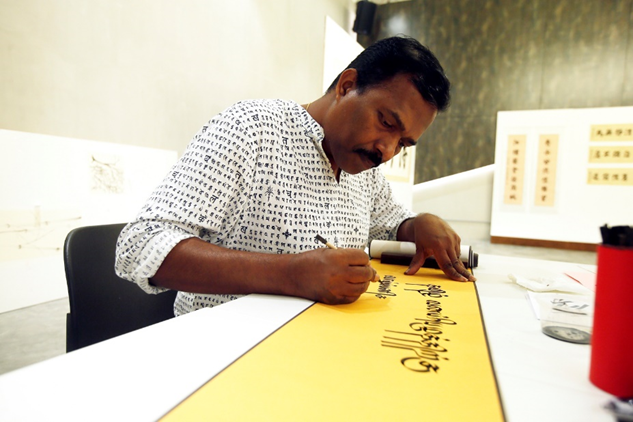
Tamil calligraphy is gaining recognition for its unique style and cultural significance. The Tamil script is written from left to right. This script comprises 247 letters, including 12 vowels, 18 consonants, 216 combinations of vowels and consonants, and one Aayuthu Ezuthu (ஃ) letter. There are vary style of artistic expression of Tamil writing however the author’s (Ts. Dr. Velu Perumal) created two Tamil calligraphy script such as “Koolevel and Thovarnavel”. The Tamil calligraphy learners especially Tamil school students are started to practice, enjoy and experience the aesthetic values of those two scripts. Tamil calligraphy emphasizes the beauty of flowing lines and shapes, contributing to its aesthetic and cultural richness. Therefore, it has a plethora of physical and mental health benefits as other scripts.
Calligraphy, with its blooming lines and profound symbolism, is a testament to the cultural diversity and artistic heritage of Malaysia. Whether it is the divine beauty of Arabic calligraphy, the graceful lines of Chinese characters, or the emerging art of Tamil calligraphy, each form tells a story of its people and their lifestyle. By understanding these art forms, one could appreciate the intricate tapestry of Malaysian culture, where lines and letters bloom from a single point into a world of beauty and meaning.




Date of Input: 16/07/2024 | Updated: 16/07/2024 | marini
MEDIA SHARING